IBM RESEARCH SPIN-OUT · IN PRODUCTION · ENTERPRISE-VALIDATED

The intelligence layer for materials safety.

Enterprises rely on hundreds of thousands of chemical compounds — and they have no scalable way to know what's actually in their products. Safer Materials Advisor uses chemistry-native AI to surface hidden risks, map global regulations, and propose safer alternatives in minutes, not months.

Faster compound review vs. manual workflows
97%
Identification accuracy across deployments
8 mo
In production at IBM Chief Sustainability Office
460+
Active users on pfasID open access
SPUN OUT OF IBM RESEARCH · 2025
Validated by leading enterprise & research programs
IBM Chief Sustainability Office
NSF Convergence Accelerator
Leading EDA enterprise pilot
IBM Sustainability Innovation Prize 2025
01 · The Problem

A $10 billion blind spot inside every supply chain.

Everyday products contain concerning chemical compounds — and companies have no scalable way to know what's actually in them.

Suppliers protect their formulations. Compounds are renamed at every step of the value chain. Regulations change across dozens of jurisdictions. A single PFAS payout from 3M reached $10 billion — and that's just the tip of the iceberg. Compliance teams are drowning in PDFs while regulators, insurers, and consumers escalate scrutiny.

→ Information loss across the value chain
Base Chemicals
PFOA
CAS 335-67-1
Formulation
Perfluoro acid
Coatings
Proprietary
fluorinated
Components
Proprietary acid
Products
No info
Consumer
?
$10B
3M's recent PFAS settlement — a fraction of total industry exposure
Trade-secret compounds that compliance teams cannot trace today
50+
Overlapping jurisdictions with diverging chemical regulations
0
Existing tools that combine ingestion, regulation, hazard & substitution
02 · The Solution

An accessible intelligence layer that understands chemistry.

Six interlocking capabilities — built on chemistry-native AI — answer the four questions every materials team needs to answer: What's in our products? How is it regulated? What's the hazard profile? And what are the safer alternatives?

01

Document Ingestion

Automated extraction from unstructured technical supplier documents — SDS, technical data sheets, regulatory filings — at scale.

02

Regulatory Intelligence

Mapping to global regulations with structure-, use-case- and jurisdiction-aware analysis for small molecules and complex polymers.

03

Hidden Substances Detection

Classification of undisclosed precursors and trade-secret compounds, with consistency checks across the supply chain.

04

Hazard Assessment

Data retrieval and predictive models for human-health and environmental endpoints — even for novel and undisclosed chemicals.

05

Substitution Engine

Safer alternatives ranked by safety, performance, cost, regulatory resilience, and other strategic dimensions.

Phase 2
06

Portfolio Risk Assessment

Audit-ready dashboards and exports with full provenance and explainability — designed for enterprise governance.

03 · Technology & IP

Three layers of defensible chemistry-native AI.

01

Knowledge & Data

A rich curated knowledge fabric with automated ingestion and extraction — and full provenance tracking from source document to inferred answer.

02

AI Models

Domain-specific foundation models and LLMs — covering analog identification, regulatory interpretation, hazard assessment, and chemical reasoning across 11 deployed FMs.

03

Application & Infrastructure

Modular agentic orchestration with hybrid cloud and on-premise deployment options — built to enterprise-grade security standards from day one.

→ The Moat

Years to replicate, not months.

  • 20B+ curated chemistry relationships in knowledge fabric
  • 11 deployed foundation models, chemistry-agnostic by design
  • Exclusive license to all SMA IP from IBM Research
  • Full commercial freedom; IBM remains a customer
  • Polymer-aware reasoning unmatched by general-purpose AI
04 · Traction

Already in production — transforming chemical coordinators across industries.

Faster compound review
97%
Identification accuracy
8 mo
In production at IBM
460+
Users on pfasID

IBM Chief Sustainability Office

  • Currently expanding user base of global chemical coordinators
  • Automation of manual workflows
  • Reduction of compliance blind spots

External Pilot · Leading EDA company

  • 100% accuracy for SDS extraction
  • Detection of not-yet-regulated compounds
  • Currently in license negotiation

Open Access via pfasID

  • NSF Convergence Accelerator — PFACTS
  • 12 months in production
  • 80 new users year-to-date
Winner of IBM's 2025 Sustainability Innovation Prize
05 · Competitive Landscape

A new category: Materials Risk Intelligence.

Adjacent platforms cover portfolio management, EHS compliance, or molecular discovery — but none combine chemistry-native reasoning with regulatory, hazard, and substitution intelligence in a single layer.

Capability
SMAMaterials Risk Intelligence
ALM / ERPSAP, IFS
EHSEnhesa, 3E, CAS
AI MaterialsCitrine, Schrödinger
Portfolio Analysis
Regulatory Interpretation
Hazard Assessment
Substitution Analysis
Chemical Reasoning
06 · Market Opportunity

A shift from reactive compliance to value creation.

TAM
$2 – 3B
Materials risk intelligence across all regulated industries globally
SAM
$0.85 – 1.2B
Materials-intensive manufacturers in North America & Europe
SOM
$50 – 150M
5-year capture rate: 200–300 enterprise customers

    Six strategic value drivers for enterprise customers
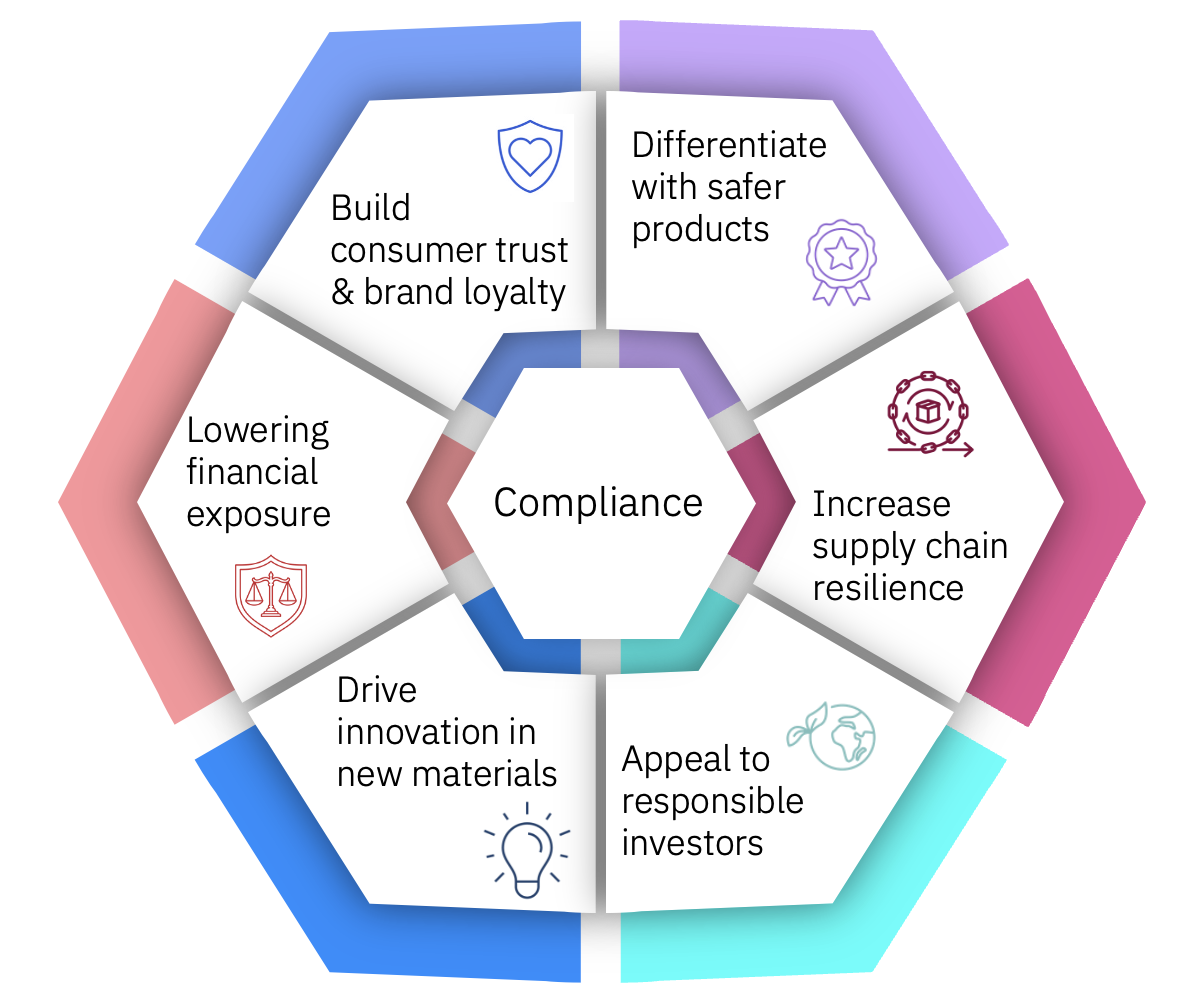
  • Differentiate with safer products
  • Build consumer trust & brand loyalty
  • Increase supply chain resilience
  • Appeal to responsible investors
  • Drive innovation in new materials
  • Lower financial & regulatory exposure
07 · Business Model

Enterprise SaaS — >90% gross margins, expansion built in.

Annual subscription with three pricing tiers, structured for the classic land-and-expand motion: identification first, substitution workflows next, enterprise-wide deployment as the engine.

Enterprise Core
$150k
per year
  • Identification & extraction
  • Regulatory & hazard assessment
  • Portfolio coverage & dashboards
  • Up to 2 supplier connections
  • Multi-tenant SaaS
Enterprise Plus
$450k+
per year
  • Everything in Advanced
  • Global multi-BU deployment
  • Tailored UX & advanced models
  • Up to 100 supplier connections
  • Up to 10 custom integrations
  • Private cloud / on-premise
Gross Margin
>90%
Across all enterprise tiers
Variable cost / customer
~$5k
Marginal infrastructure & support
Annual fixed cost base
$2.85M
Personnel-led, capital-efficient
Customers to break-even
15 – 20
A defensible, achievable target
08 · Product Roadmap

From revenue today to category leadership in 36 months.

PHASE 1 · 0–6 months
Revenue-generating

Identification & Regulatory Intelligence

  • Fully automated document ingestion
  • Polymer-aware regulatory classification
  • Chemical hazard assessment
  • Portfolio-level dashboards
Production-ready platform supporting immediate sales
PHASE 2 · 6–18 months
Contract expansion

Substitution Pipelines & Design Partner Program

  • Build & validate substitution pipelines
  • Performance & formulation prediction models
  • Multi-objective optimization engine
  • Establish design partner program
Validated substitution engine with proven enterprise value
PHASE 3 · 18–36 months
Category leadership

Full Materials Strategic Intelligence

  • Evaluation of starting materials
  • Optimization of processing & synthesis
  • Recycling & recovery proposals
  • Sourcing strategy integration
Differentiated platform supporting sustainability, circularity & resilience
09 · Founding Team

Deep science meets enterprise AI — built together at IBM Research.

KS

Kristin Schmidt

Co-Founder · CEO

PhD Polymer Chemistry, University of Bayreuth. Leading the SMA initiative at IBM Research with deep expertise in polymer science and enterprise materials strategy.

DB

Dave Braines

Co-Founder · CTO

PhD Artificial Intelligence, Cardiff University. Senior IBM Research scientist driving the agentic AI architecture, foundation models, and enterprise platform engineering.

DS

Dan Sanders

Co-Founder · CSO

PhD Chemistry, California Institute of Technology. Chemical-risk methodologies and scientific strategy, with two decades of materials science research at IBM.

Early Technical Team

Four current researchers from IBM Research spanning materials modeling, LLM and agentic engineering, platform architecture, and chemical risk methodologies — all committed to the spin-out.

IBM Spin-out Structure

Spin-out contingent on closing the seed round and initiated immediately after funding. Exclusive IP license, full commercial rights, NSF Convergence Accelerator funding transferred. IBM retains a small equity share and continues as a customer.

10 · The Ask

A $6M seed to spin out, scale, and lead a new category.

SEED ROUND
$6M
Pre-money
$25 – 30M
Existing
$0.9M committed
Runway
24 months
ARR target Y1
$1 – 1.5M

Use of funds

Product & R&D 50 – 55%
Chemistry models, regulatory intelligence, substitution workflows
Engineering & Infrastructure 20 – 25%
Cloud, AI inference, security, DevOps, support
Commercialization 10 – 15%
Founder-led GTM, conferences, customer success
G&A ~10%
Legal, accounting, insurance, operations

Seed milestones at month 18 – 24

  • Complete IBM spin-out post-funding
  • $1 – 1.5M ARR within 12 months
  • 3 – 5 enterprise design partners
  • Substitution engine MVP validated
  • Enterprise security certifications (SOC 2, ISO 27001)
  • Series A readiness
11 · Risks & Mitigation

Honest about the risks — prepared for each.

Risk
Mitigation
Technology Risk
Models don't generalize beyond PFAS
Knowledge fabric and foundation models are chemistry-agnostic by design — 11 deployed FMs already handle polymers and small molecules across chemical classes.
Spin-out Execution
IBM changes terms or key people don't leave
Terms agreed; 7 team members committed; exclusive IP license secured. IBM is incentivized as a continued SMA licensee.
Commercial Risk
Research team can't sell enterprise software
Pipeline already built from inside IBM with no sales team; advisory board covers startup & GTM gaps; founder-led sales is the standard path at seed.
Market Timing
PFAS regulation gets delayed
Regulatory pressure is diversifying across US states independently; insurer scrutiny and supply chain disruptions create demand regardless of timeline.
Competitive Entry
Well-funded player enters the market
Moat requires curated domain data (20B+ relationships), specialized chemistry models, and enterprise workflows — years to replicate, not months.
→ Let's talk

In production. Enterprise-validated.
Ready to scale.

We're raising a $6M seed to build the intelligence layer for global materials safety. Detailed financials, the data room, and the technical brief are available on request.

KS
Kristin Schmidt
Co-Founder & CEO · Safer Materials Advisor
schmidkr@us.ibm.com +1 (650) 283-1311